
Category: COVID-19

May 1 Emergency Directives Require Continuances, Authorize Remote Proceedings, and Extend Time to Pay

Chief Justice Cheri Beasley entered an order on Friday, May 1, modifying and extending eight emergency directives previously issued on April 2 and April 16, 2020.  The Chief Justice’s April 2 order, in which noted that she fully expected to extend its directives for an additional 30-day period and that judicial system stakeholders should plan for the directives to last through May, presaged the current one. Emergency orders issued by the Chief Justice pursuant to G.S. 7A-39(b)(2) initially may endure for no more than thirty days, but may be extended for additional 30-day periods. Friday’s order was effective immediately and expires on May 30, 2020.

As before, three of the emergency directives are particularly significant in criminal cases.
2020 Sentencing Commission Statistical Report Available

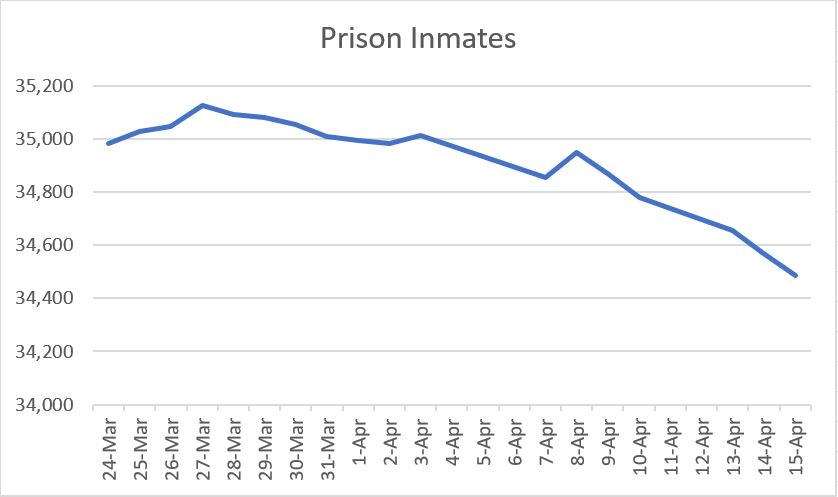
Correctional statistics have been in the news as we consider the impact of the coronavirus on our jails, prisons, and supervised populations. This week the Secretary of Public Safety announced a decision to extend the limits of confinement for certain categories of inmates under G.S. 148-4 (the general plan is outlined here). That (in conjunction with the existing moratorium on new entries) caused the prison population to fall throughout the week. Advocates continue to push for broader releases.

But today’s post isn’t about what’s happening now to get certain inmates out of prison. Instead, it’s a review of the last year’s worth of data on how those inmates got there in the first place. The North Carolina Sentencing and Policy Advisory Commission recently published its annual Structured Sentencing Statistical Report for Felonies and Misdemeanors. Here are the highlights.

Filing Deadlines Further Extended to Combat COVID-19; Colloquy and Form Available for Remote Proceedings

Chief Justice Cheri Beasley entered an order yesterday extending until June 1, 2020 the time and periods of limitations for documents and papers due to be filed and acts due to be done in the trial courts. The Chief Justice previously had extended to April 17, 2020 the deadline for filings, periods of limitation and other acts. She further extended those deadlines based on predictions that late April “may be the apex of the [COVID-19] outbreak in North Carolina.”

Two-Week Moratorium on Inmate Transfers to Prison

Effective today, the North Carolina Department of Public Safety has placed a 14-day moratorium on the movement of inmates from the county jails to the state prison system. State officials made the decision with the support of the North Carolina Sheriffs’ Association to help manage the COVID-19 pandemic.

April 2 Emergency Directives Require Continuances, Authorize Remote Proceedings, and Extend Time to Pay

Chief Justice Cheri Beasley entered an order last Thursday, April 2, 2020, imposing emergency directives that were immediately effective and that affect criminal cases.

Legal authority. The Chief Justice’s order was entered pursuant to G.S. 7A-39(b)(2), which permits the Chief Justice, after determining or declaring that catastrophic conditions exist in one or more counties of the state, to issue emergency directives necessary to ensure the continuing operation of essential trial or appellate court functions. Such directives are effective notwithstanding any other provision of law.

Sentencing Health Control Measures

Whenever I teach about Structured Sentencing, I usually start by saying that the law covers most North Carolina crimes, with a few exceptions. Capital felonies and violent habitual felons have their own sentencing rules. And of course so does impaired driving. But a final exception carved out of Structured Sentencing in G.S. 15A-1340.10 is G.S. 130A-25, failure to comply with health control measures. I don’t typically spend much time on those rules, though, as there are only a handful of convictions under them in the state each year (seven in 2019). Now seemed like a good time to take a look.

New Executive Orders Affect DMV Operations, Prohibit Certain Gatherings of More than 50 People, and Direct Entertainment Facilities and Hair Salons to Close

The Governor issued Executive Order No. 119 on Friday, which orders the closure of many Division of Motor Vehicles (DMV) Driver License Offices, the postponement of certain DMV hearings, and the suspension of road tests for newly licensed drivers. Today, the Governor issued Executive Order No. 120, which prohibits mass gatherings of more than 50 people, orders the closure of entertainment facilities and personal care and grooming businesses, and extends the closure of public schools through May 15, 2020.