This year, the School has been tasked with several projects under the research mandate in Session Law 2025-93 (H.B. 307, “Iryna’s Law”). This post summarizes the preliminary findings for one project, which focuses on the scope and availability of pretrial electronic monitoring throughout the state.
Along with several other changes to pretrial release, which have been discussed previously on the blog, Iryna’s Law called for an expansion of pretrial electronic monitoring. Specifically, section 1. (g) reads:
No later than [December 1, 2025], each judicial district that does not already have the capability of imposing house arrest with electronic monitoring under G.S. 15A-534(a)(5) shall enter into a Memorandum of Agreement with a qualified vendor to provide such services. A defendant released with the condition of house arrest with electronic monitoring shall be responsible for paying for the services provided by the qualified vendor.
Section 4 of the law also requires a study of “the availability of house arrest as a condition of pretrial release in each county or judicial district.” The School was selected to carry out this study with support from the North Carolina Collaboratory.
To learn more about the availability of pretrial electronic monitoring, we sent a survey to the state’s senior resident superior court judges, chief district court judges, and pretrial services directors in April 2026. We also sent the survey to select Sheriff’s Offices in instances where we had not yet heard from another stakeholder in their county.
While Iryna’s Law specifies house arrest with electronic monitoring, our survey focused on the availability of technology and equipment to satisfy the electronic monitoring component. Some counties we surveyed use electronic monitoring as part of true house arrest, where the defendant is required to remain at his or her residence unless the court authorizes the person to leave for specified purposes. Others use it for more generalized electronic monitoring, like the monitoring imposed on certain defendants charged with crimes of domestic violence, where the individual is barred from entering certain “exclusion zones,” but can otherwise leave their home without restriction. By the end of June 2026, we had fifty-six complete survey responses covering ninety-two of the state’s 100 counties.
Scope and Availability of Pretrial Electronic Monitoring
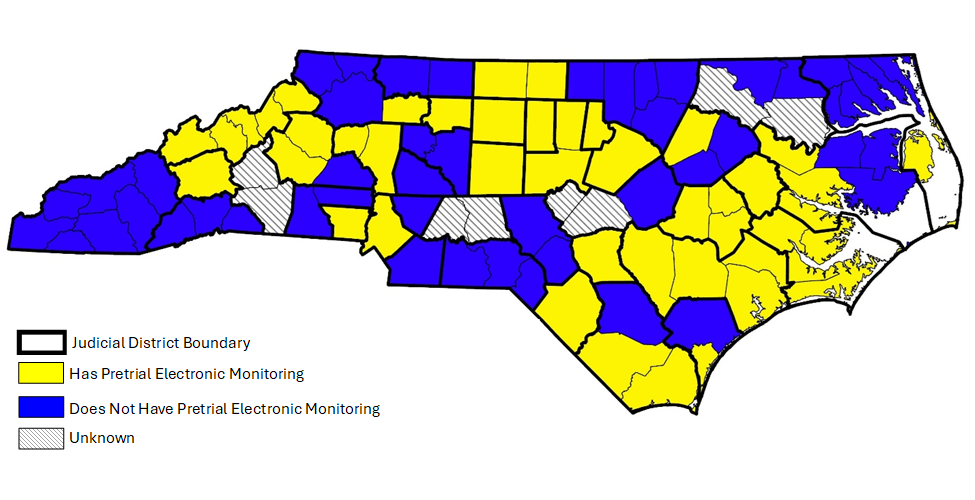
Forty-three counties reported that they have some form of pretrial electronic monitoring. Local court systems are also divided into forty-one district court judicial districts, which are represented by the bold boundary lines on the map below. Only nineteen districts (46.3%) reported having pretrial electronic monitoring district-wide by June 2026, with twelve of those being single-county districts. Seven districts (17.1%) had a mix of counties that did and did not have pretrial electronic monitoring. Eleven districts (26.8%) had no counties with pretrial electronic monitoring (Figure 1).
In four districts, the availability of pretrial electronic monitoring is not fully known, as we did not receive a complete survey response from all of the counties in the district.
Figure 1. Map Showing Availability of Pretrial Electronic Monitoring Statewide
Vendor Relationships
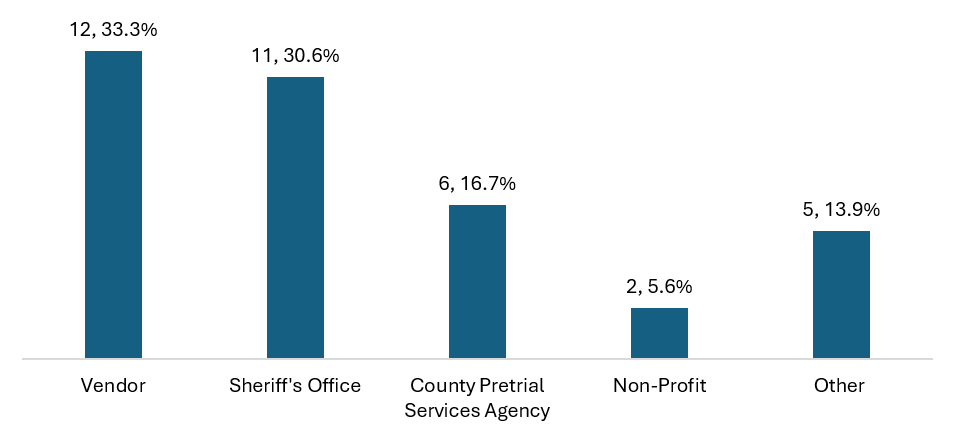
Of the forty-three counties with pretrial electronic monitoring, sixteen reported partnering with a vendor. Vendors mentioned by multiple counties include Tarheel Monitoring, BI Monitoring, AMS, and Buddi. All sixteen counties reported that their vendor provided ankle monitors, and thirteen reported that the vendor provided monitoring software. The vendors’ level of involvement in providing supervision varied. Twelve counties said that the vendor provided monitoring services and was responsible for the day-to-day supervision of individuals on pretrial electronic monitoring. When the vendor was not providing day-to-day supervision, that responsibility was typically designated to a county-level pretrial services agency, a non-profit organization, or the Sheriff’s Office (Figure 2).
Figure 2. Entity Responsible for Day-to-Day Supervision of Individuals on Pretrial Electronic Monitoring
Funding
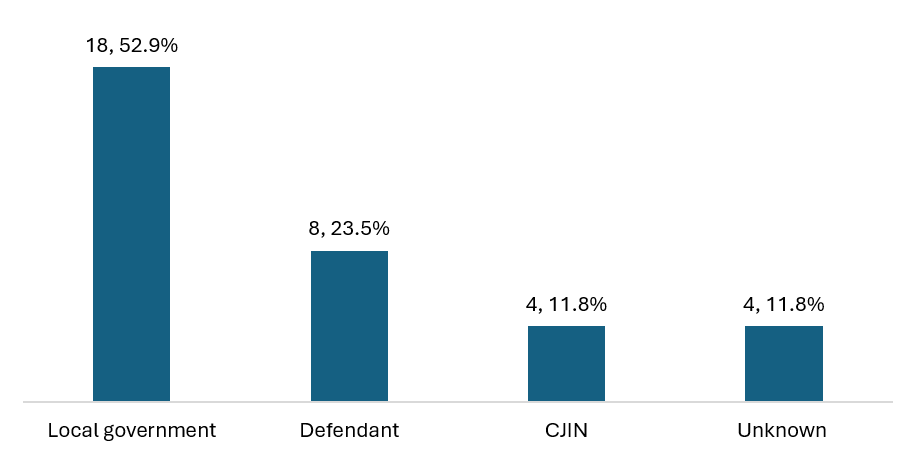
Almost half of the counties with pretrial electronic monitoring reported paying for equipment, like ankle monitors, through local government funding (21, 48.8%). The next most common source of funding for equipment was the Criminal Justice Information Network (CJIN) (12, 27.9%). The CJIN program, which was referred to as “Caitlyn’s Courage” prior to 2021, was available in select counties and operated and paid for by the state. The program provided pretrial electronic monitoring for individuals who met certain criteria, primarily that they were accused of a crime involving domestic violence, stalking, sexual assault, or a violation of a domestic violence protection order.
The 2026 State Budget Act eliminated CJIN and transferred responsibility for operating the domestic violence pretrial electronic monitoring program to the State Bureau of Investigation (S.L. 2026-41, p. 470). At this time, it is not clear whether there will be any changes to the scope or operation of the program as a result of the transfer to the SBI.
Most counties also reported that local government funding pays for the day-to-day costs of pretrial electronic monitoring (Figure 3). However, eight counties said that defendants pay all or some of the costs.
Figure 3. Funding Sources for Day-to-Day Operation of Pretrial Electronic Monitoring
Counties Without Pretrial Electronic Monitoring
Forty-nine counties reported having no pretrial electronic monitoring capabilities. Of those counties, forty-two (85.7%) said that there had been no coordinated discussions about establishing pretrial electronic monitoring. Three counties (6.1%) said stakeholders were working to establish a program, but decisions were not yet finalized, and four (8.2%) said a program was almost operational.
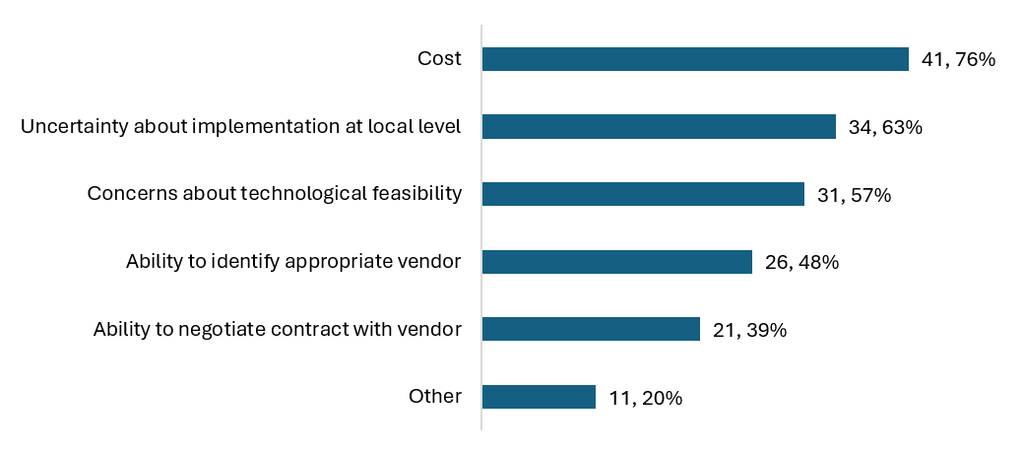
When asked about challenges, cost was the number one concern, with 76% of respondents citing it as a barrier to implementing pretrial electronic monitoring (Figure 4).
Figure 4. Barriers to Implementation of Pretrial Electronic Monitoring
Looking Ahead
Nearly ten months after the December 1, 2025 deadline in Iryna’s Law for judicial districts to establish pretrial electronic monitoring capabilities, statewide implementation remains far from complete. Only nineteen districts report having these capabilities district-wide.
Concerns about cost emerged as a central obstacle, as 76% of respondents without pretrial electronic monitoring cited cost as a barrier to implementation. While Iryna’s Law addresses funding by requiring the defendant to pay for vendor-provided services, this model is not common among current programs. Only sixteen of the forty-three counties with pretrial electronic monitoring capabilities reported working with a vendor at all, and only eight reported that they pass on some or all of the cost to the defendant.
In addition to this survey, the School has conducted stakeholder focus groups to gather more information on barriers to implementation and the characteristics of successful pretrial electronic monitoring programs. In March 2027, we will produce a report to the General Assembly, which will provide additional insight on program structure, vendor relationships, funding models, and lessons learned that may assist local leaders in establishing pretrial electronic monitoring programs in their jurisdictions.
If you’re interested in reading more about the preliminary findings from the survey, you can find a full briefing paper here. If you have questions, please reach out to me at hturner@sog.unc.edu, or Shea Denning at denning@sog.unc.edu.
