By now the last fiscal year is pretty far back in everyone’s rear view mirror. Nevertheless, I am excited to share the North Carolina Judicial College’s annual report for 2025-26. Folks, we’ve been busy!
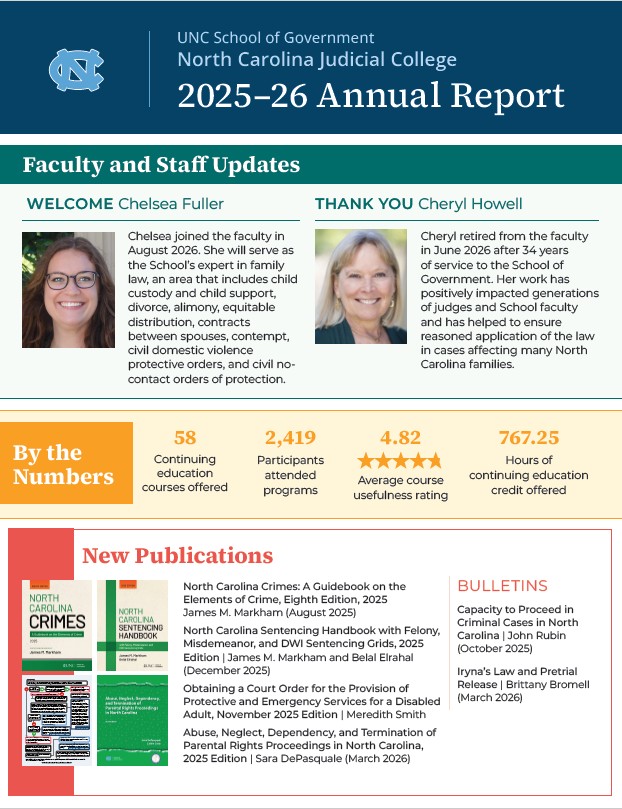
We offered 58 continuing education courses last year, setting a new record. Those courses provided more than 750 hours of continuing education credit. They included an inaugural North Carolina Supreme Court Seminar for Clerks and Magistrates along with staples such as Presiding Over DWI Cases: What Magistrates and District Court Judges Need to Know, Capital Case Law for Superior Court Judges, and Judicial Decision-Making for Magistrates. The report describes those courses and contains participant reviews. We had plenty of reviewers to choose from as program enrollment for 2025-26 exceeded 2,400 participants!
Last year we again offered (in conjunction with the UNC School of Law) the Sentencing Seminar, which brings together law students, judges, prosecutors, defense attorneys, and probation and parole officers over three weekends to explore and discuss sentencing practices and philosophies. And another cohort of judicial district executive leadership teams (this year from districts 15, 35, and 27) attended our leadership and case management series, Getting Justice Done.
We also were delighted to participate in the awarding of certifications to several officials. Seven district court judges received the Advanced Juvenile Justice Certification and 34 magistrates were certified, 20 in criminal law and 14 in civil law/small claims. The report lists those officials by name and district; if you know them, please extend your congratulations.
In addition to courses, the report features several recent publications, including the latest edition of North Carolina Crimes, an updated North Carolina Sentencing Handbook, and bulletins on capacity to proceed and Iryna’s Law.
We consistently strive to deliver top-notch instruction and to publish in-depth, insightful, and practical reference materials that equip judicial branch officials with the skills and knowledge they need to carry out their important work. We hope that this summary of our work demonstrates our success in meeting these goals.
The work of the North Carolina Judicial College is supported by, and would not be possible without, our longstanding partnership with the North Carolina Administrative Office of the Courts (AOC). We thank the AOC along with judicial officials across the state for their ongoing support.
If you have questions or comments about the work of the North Carolina Judicial College (including suggestions for improvement), please share your thoughts with me at denning@sog.unc.edu.
