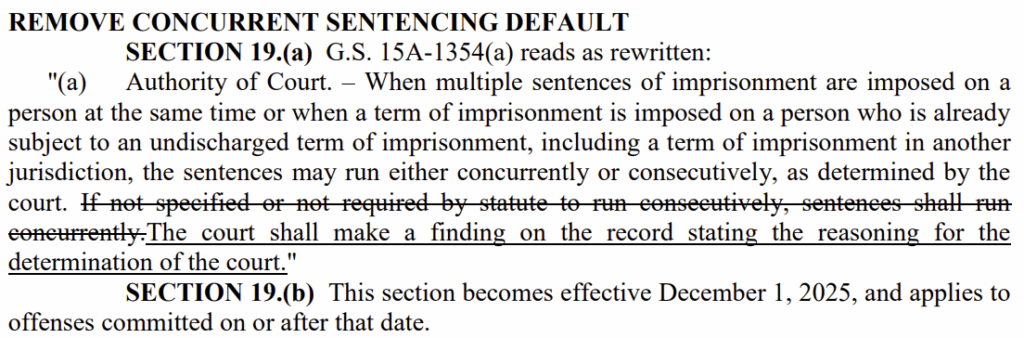
For many years, it has been the rule in North Carolina that when multiple sentences of imprisonment are imposed, they run concurrently by default. That has been required by statute since 1977. G.S. 15A-1354. And that statute carried forward prior law that “sentences are to run concurrently unless otherwise specified.” Id. Official Commentary. Effective today, that default rule is removed.

Under G.S. 15A-1354(a), “[w]hen multiple sentences of imprisonment are imposed on a person at the same time or when a term of imprisonment is imposed on a person who is already subject to an undischarged term of imprisonment, including a term of imprisonment in another jurisdiction, the sentences may run either concurrently or consecutively, as determined by the court.” Previously, the law went on to say that “[i]f not specified or not required by statute to run consecutively, sentences shall run concurrently.” Effective for offenses committed on or after December 1, 2025, that provision is deleted, with the result being that there is no default under G.S. 15A-1354. Instead, a new provision is added stating “[t]he court shall make a finding on the record stating the reasoning for the determination of the court.” S.L. 2025-70, section 19.(a). So, the court must decide whether the sentence being imposed will run concurrently with or consecutively to other sentences being imposed at the same time, as well as any other existing terms of imprisonment.
The Administrative Office of the Courts has prepared new forms (see, e.g., AOC-CR-601), giving the court space to make the statutorily required finding on the record, including the reasoning for its determination.

I’ll dig a little deeper on several aspects of the revised law.
Effective date. The new rule is effective for offenses committed on or after December 1, 2025. That means there will be a little bit of lag time before the requirement for findings and reasoning in revised G.S. 15A-1354 kicks in. Eventually, there will be situations in which a new sentence for an offense committed on or after December 1, 2025 will be imposed alongside a sentence for an offense committed before that date—whether that’s for a sentence already being served, or for one being imposed at the same time. There will also be probation revocations where the sentence being activated pre-dates the requirement for any special findings. There’s nothing inherently wrong with all of that, but for the next few years courts will need to be attentive to the offense date of the crime being sentenced to be sure they make the requisite findings.
No impact on consolidated sentences. The revised rule applies when multiple sentences of imprisonment are imposed. It does not impact the court’s authority to consolidate multiple offenses for judgment and impose a single sentence. See G.S. 15A-1340.15(b) (consolidating felonies); 15A-1340.22(b) (consolidating misdemeanors).
Not all statutory defaults for concurrent sentences were removed from the law. G.S. 15A-1354 falls in Article 83 of Chapter 15A of the General Statutes, which sets out the general rules for “Imprisonment.” There are some additional provisions within Article 81B (Structured Sentencing) that pertain to the sentencing of multiple convictions.
First, there is G.S. 15A-1340.15(a), which sets out the rules for multiple convictions for felonies. It reads “Unless otherwise specified by the court, all sentences of imprisonment run concurrently with any other sentences of imprisonment.” That provision was not amended by S.L. 2025-70, raising the argument that multiple felony judgments that are silent on the consecutive-concurrent issue should be run concurrently by default. However, it’s not clear that the continued existence of a default for felonies relieves the court of its new duty to make findings for its determination. As a practical matter, custodians (generally DAC) who receive a judgment that doesn’t specify consecutive or concurrent are likely to send it back for clarification.
Second, G.S. 15A-1344(d) continues to read “A sentence activated upon revocation of probation commences on the day probation is revoked and runs concurrently with any other period of probation, parole, or imprisonment to which the defendant is subject during that period unless the revoking judge specifies that it is to run consecutively with the other period.” In the short run, most activated probationary sentences will be for offenses that were committed before December 1, 2025, and that are therefore not subject to the new rule in G.S. 15A-1354. As time goes on, courts will need to consider how to harmonize the extant default in G.S. 15A-1344(d) with revised G.S. 15A-1354. Again, as a practical matter, a custodian in receipt of a judgment and commitment upon revocation of probation is probably going to seek clarification if no decision is memorialized on the form (which does now include space for a decision and the underlying reasoning, see, e.g., AOC-CR-607).
Third, G.S. 15A-1346 continues to read “If a period of probation is being imposed at the same time a period of imprisonment is being imposed or if it is being imposed on a person already subject to an undischarged term of imprisonment, the period of probation may run either concurrently or consecutively with the term of imprisonment, as determined by the court. If not specified, it runs concurrently.” That provision is about probation start dates, not terms of imprisonment, so it isn’t at odds with revised G.S. 15A-1354. But it uses similar language, and so I wanted to at least point it out.
Reasoning. Revised G.S. 15A-1354(a) requires the court to “make a finding on the record stating the reasoning for the determination of the court” as to consecutive or concurrent sentences. Notably, the provision does not require “findings of fact.” It’s a “finding stating the reasoning.” I don’t know of another statutory provision exactly like that, but my guess is that it will not be viewed as requiring a detailed exposition of the sentencing court’s reasoning. Cf. State v. Wilkerson, 223 N.C. App. 195, 200 (2012) (noting, in the context of the required findings for a longer period of probation under G.S. 15A-1343.2(d), that “the statute merely requires a finding that a longer term is needed; it does not require detailed rationale”). I would expect you’ll see a lot of reasoning like “in the interests of justice,” “consistent with historical practice,” “required by law” (if all the sentences are for Class 3 misdemeanors, for example), or—perhaps most frequently—“pursuant to the plea agreement.”
Fiscal impact. The fiscal note on Senate Bill 429 was prepared before the provision removing the concurrent sentence default was added to the bill. The North Carolina Sentencing and Policy Advisory Commission did some analysis of the proposed change in its Review of Proposed Legislation, as required under G.S. 164-43. In the version of the bill analyzed by the Commission, the proposed rule was the sentences would be presumed to run consecutively. That’s not where the final version of the law wound up; instead, it eliminated any default and required the court to make an election between consecutive and concurrent sentences and explain it.
Nevertheless, the data presented by the Commission are interesting. The Commission review indicated that of the 27,088 felony sentences entered in 2024, 55 percent had two or more convictions as part of the sentencing episode. Of that 55 percent, 30 percent received consecutive sentences and 70 percent received concurrent or consolidated sentences. The Commission then made projections of the prison bed impact of the new rule depending on how many of those erstwhile concurrent sentences wind up consecutive under the revised rule. If, for example, a quarter of the eligible pool were to flip from concurrent to consecutive, the prison bed impact is 431 beds over the next five years. The full analysis is on page 67 of the report linked above.
